Showing posts with label processing fleece. Show all posts

Tuesday, April 15, 2014

Processing and spinning Qiviut

 Qiviut is the warm, soft undercoat of the musk ox. It keeps the musk ox warm in its native habitat of the arctic regions in places such as Canada, Greenland, Sweden, Siberia, Norway, and Alaska. It is a rare fiber and expensive.
 
I recently purchased 1 ounce of raw qiviut fiber from the University of Alaska Fairbanks' Large Animal Research Station. You can watch how they comb the shed qiviut from their musk oxen here.
 
Below is the one ounce of raw qiviut that I bought:
 
 
The long hairs have to be pulled out by hand. They are soft, but stiffer and not as fine as the qiviut undercoat. What you want is just the wonderful, soft undercoat. Below is the same one ounce, now a bit lighter, after it's been dehaired:


I kept the hairs that I took out of the qiviut, carded them and spun them up. I got about 24 yards of yarn. It's very soft to the hand, but prickly up against the neck. Here it is with the unspun qiviut:
 

Below, I'm holding a segment of the unspun, dehaired qiviut fiber. I spun it right from these segments of the dehaired blanket without washing, carding or combing:


It spun up wonderfully, here is the singles on a bobbin:


And here is the two-ply yarn:
 

It is a wonderfully soft and light yarn with no prickles. I got approximately 84 yards, and, after washing, it weighed in at approximately 0.7 ounces. It reminds me very much of the paco-vicuna I've spun; it's got the same heavenly softness and cloud-like weight. And the same high price-tag. I used to think that qiviut was very much the same as yak, but it's not. Yak is also very soft and warm, but it's not as fine and cloud-like as qiviut. Yak is a lot more dense, but still a very nice, soft fiber, and a lot less expensive than qiviut.

I really like the qiviut, I only wish I could afford enough to make something like a sweater - we all can dream, can't we?

Monday, June 17, 2013

Babydoll Southdown Wool

I really like babydoll Southdown wool for one big reason, it can be machine washed and dried without shrinking or felting. I have a pair of socks I made out of some babydoll Southdown that I dyed with Japanese indigo last summer. I've thrown them in with regular wash loads several times and dried them as well and they still fit and are still comfy and warm.

I purchased a raw babydoll Southdown fleece at the recent Great Lakes Fiber Show. It was a really nice mix of light shades of gray. Here's s portion of it getting ready for a wash:


You can see the shades of gray and the sun-bleached tips. I really liked the grays for themselves, but I thought that they would add a really nice depth to any color I might dye it, too:


I took about an ounce of the washed fiber and carded it up into a batt. Carding is the way to go with babydoll fiber because it has such a short fiber length - it wouldn't really work well on the combs.
 
I then divided the batt up into four sections and dyed each section a different color:


Then I mixed the colors on the drum carder:
 

Here's the mixed batt, I only ran it through the drum carder once. The colors would blend more fully with each successive run through the carder, but I wanted them more distinct:


And here's a ball of the carded roving ready to spin:


I went ahead and spun the whole one-ounce batt into a singles, then pulled off a bit and let it ply back on itself into a short length of two-ply and knitted up a quick swatch:
 

I think it'll make some nice, colorful socks. I'm planning on carding and dyeing and spinning another three ounces in the same colors for a nice, 2-ply skein of sock yarn for wool socks that don't have to be hand washed and lain out to dry!

Tuesday, May 28, 2013

Border Leicester Wool

Today I combed a small amount of some of my Border Leicester fleece that I got at the Maryland Sheep and  Wool Festival. Border Leicester is a breed in the luster longwool category of wools. The staple length is long and it has a nice luster. The staple length of my fleece is at least 6".

Here is washed lock from the fleece:


And here is some of the washed fleece:


I spun a small amount up into some laceweight yarn and knitted a small swatch of lace. I suspected that a Border Leicester lace yarn would have very good stitch definition, and it does:
 
 
 My little ball of two-ply yarn was about 15 yards long. I've only used a little bit of it on this swatch, which is about 2.5 inches long right now. I might be able to get a cuff-length piece of lace edging if I continue until the yarn runs out.

 
 I'm not sure if you can see the bit of luster in the yarn in this picture, the lighting came out funky, but I think you can see it on the lace in the background (click on the pic to see it larger):
 

 So I think I will definitely use a portion of my Border Leicester fleece to make laceweight yarn. I'll have to think about if and how to dye it.

Tuesday, January 1, 2013

Dyeing milk protein fiber and de-hairing Paco-vicuña

The mail brought a wonderful thing to my doorstep yesterday - this raw Paco-vicuña fleece:


Well, that's really just the blanket, not the whole fleece, but I have the rest, too.

Like alpaca, Paco-vicuña needs to be de-haired before it can be further processed. In this picture, you can see the guard hairs sticking up from the rest of the fleece:


The fleece has a micron count of 16.3, pretty darn fine. The guard hairs are stiffer and thicker and need to be gotten rid of so that they don't spoil the fineness of the rest of the fiber. I don't know how this is accomplished by machinery in a mill, but if you are doing it for yourself, the hairs must be pulled manually from the rest of the fleece. It's not hard, it just takes a while.
 
Here you can see the bit of fleece from the above picture after it's been de-haired:


All that's left is the wonderful, fluffy, Paco-vicuña fiber. Now it's ready to be washed (soaked, really) and then further processed (I'll probably card it as it's a little short for combing) so that it can be spun into luscious Paco-vicuña yarn.
 
I also had the chance to dye up some recently spun milk protein yarn. The milk protein was in a wonderfully big box full of spinning fiber that was under the Christmas tree. Milk protein, made from milk in a similar way that bamboo fiber and tencel fiber is made, is wonderfully silky. It breaths well and contains anti-microbial amino acids (which can help with the stink factor in sweat).
 
I had two 2 oz. skeins to dye up. The pinky-orange-yellow color was achieved by winding the skein into a ball and then squirting pink and yellow weak acid dye (set with vinegar) into and all over the ball. The color was set with heat by microwaving the ball for about 3 minutes.
 
The golden color of the other skein was achieved with a natural dye made from Tesu flowers, the extract of which I ordered online. I mordanted the skein with alum first, and then plunked it into the dye pot. The golden color, particularly on the shiny, silky milk protein fiber, is luscious and exactly what I wanted:
 

I'll be using this yarn when I go to a Knitted Knockers Knit-in next week where we all will be knitting prosthetic breasts to donate to women who've had mastectomies. Lot's of these women really like knitted boobs over the silicone prostheses because they're more realistic, breath, can be worn with their regular bras, and can be adjusted by adding or subtracting the amount of fill.

I'll be spinning the rest of my milk protein and dyeing it up in anticipation of the knit-in next week. And then, I'll be concentrating on Paco-vicuña, of course!


Wednesday, April 18, 2012

A homemade basket for washing fleece in the tub

I've been contemplating an easier way to wash raw fleece in the tub. I decided that some sort of basket would be the best thing. The fleece could be put into the basket, the basket and fleece submerged in the tub's soapy, hot water and left to soak. The basket could be lifted out of the tub to drain the dirty water and refill the tub with either more hot, soapy water, or hot, fresh rinse water, and then the basket re-submerged.

I went to the hardware store to scope out materials, and came home with a 3x15 foot roll of plastic hardware netting, the sturdy, yet still flexible kind that can wrap around tree trunks to protect them from deer, not the really flimsy netting that goes over berry bushes:


Here's the resulting basket along with the materials used to make it, netting, twine, and scissors:


 It was really easy to cut the netting to the right size and then fold the ends up to make a basket:


 The extra material at the corners was folded to the outside of the basket so that fiber wouldn't catch in the fold on the inside, and then tied in place with the twine:


I braided a length of twine and used it as handles, but I think I'll remove the handles and add loops along this edge for dowels to slide into. This will make it easier to lift the basket out of the tub to hang, resting on the dowels which will in turn rest on the edges of the tub, when changing the water in the tub:


Here is some Icelandic fleece in the basket, waiting for the tub to fill with hot, soapy water:


Here's the fleece soaking in the tub. It's so easy to place it into the water and let it soak this way. There's no agitation to felt the fibers:


I lifted the basket out and placed it on an old screen resting on the edges of the tub while I drained the filthy water and refilled for one more soapy soak. Again, very little agitation was induced:


After two soapy soakings and one rinse soak, it was easy to lift the fiber out of the tub. I let it drain overnight sitting on the old screen over the tub, and this morning it's drying outside in the sunshine:


This basket is super easy to make. The roll of plastic netting cost something like $16, and the hemp twine cost about $2. There's plenty of netting left to make more baskets, or use in the yard. If you wash raw fleeces, I'd recommend using a basket, it really makes things easy.

Friday, March 9, 2012

Making blended sock yarn

I've been working on making some sock yarn with a baby alpaca fleece that I bought last summer at a fiber festival. I wanted to blend in some nylon for durability and some silk for both durability and silkiness. In the picture below, the nylon is on the left, the silk is in the middle, and the washed baby alpaca fiber is on the right. The fleece was a gorgeous mix of gray-white, medium-gray, and darker gray with bronze tips:


The blend was approx. 6% nylon, 6% silk, and 88% alpaca. I blended three different bats with my drum carder. I ended up with a light-gray bat, a medium-gray bat, and a darker-gray bat because I randomly plucked the handfuls of alpaca from the varied fleece. one handful had more of the light fiber in it, one had a more even blend, and one had more of the dark fiber in it. The fiber in the picture above produced the medium-gray bat, which is to the right in the picture below (the light bat is to the left):


Here are the light and medium bats rolled out. At this point, the third, darkest bat hadn't been made yet:


The yarns made with these bats are pictured below. The medium-gray is on the top left, and the light-gray is on the top right:


The yarn made with the dark-gray bat is still hanging to dry on a doorknob after letting it soak to set the twist:


All told, I came out with just over 400 yards of yarn. I would classify it as a light sport weight or a heavy fingering weight. I was considering putting it up for sale, but I think I'm going to make a pair of socks for myself instead, the yarn is very soft and silky.

This fleece already produced 256 yards of sport weight, two-ply yarn (unblended), and I have enough fleece left for maybe another 400 yards, give or take.

So in the end, I'll get somewhere around 1,000 yards of sport weight/fingering weight yarn out of this fleece, which I purchased raw for about $38.

Monday, February 27, 2012

Icelandic fleece, or, entering the world of tog and thel

I recently received an order of two raw Icelandic fleeces. One is white/oatmeal in color and the other is a brown/red.

Icelandic sheep are a bit unique in that they produce two types of wool in one fleece. Usually if a sheep produces both long and short fibers, the longer ones will be kemp or guard hair, which is structurally different from wool. The Icelandic breed of sheep produces both long and short fibers, but they are both wool.

The longer fibers are called tog, and the shorter fibers are called thel.The two fibers can be separtated fairly easily by pulling the longer fibers out while keeping hold of the shorter ones. Traditionally the children were set to this task.

The long tog fibers make an excellent warp yarn when spun, and the short, cushy, warm thel fibers make wonderful yarn for sweaters and the like. 

Viking combs were designed for this fiber, and I wish I had some, but I have four-pitch wool combs, which won't work well with this fiber. Anyway, I washed a bit of both of my fleeces and this morning I set about separating the tog from the thel of the red/brown fleece.

The picture below shows the piece of fleece at the top, and some which has been separated below it. The short, warm thel is on the bottom left, and the longer tog is on the bottom right (click on any of the pictures to see them closer):


Again, a piece of whole fleece:


And the same piece separated into thel (left), and tog (right):


I have a couple of dog combs which I used to in place of Viking combs to comb out both types of the wool, separately. I then carded the short thel wool with hand cards and made two rolags, and I pulled the tog off of the combs into a short piece of roving. They are picutred below, the two rolags of short, cushy thel are on the top, and the tog roving is on the bottom. You can easily see the difference between the two types of wool produced from this one fleece. Both are soft to the touch:


I have a lot more to process, this was just a little test of how to go about handling Icelandic wool, it's my first time. You can also skip separating the fibers and card everything together and spin it. I'll try doing it that way, too. Apparently the longer tog stays toward the center of the yarn and the softer thel migrages to the outside. I can't wait to spin it separated and all carded together.

Thursday, January 19, 2012

My white alpaca fleece

Last fall, I purchased  a white, first shearing fleece which came off of a 10-month old alpaca named, "Powdered Sugar." I finally have the time to process it. Two days ago I unrolled the fleece and sorted it. Here it is, shorn side up: 


I have to apologize ahead of time for the quality of the pictures. I took them one-handed with my cell phone, and the flash was off, so they all came out a little blurry.

My cat, Freki, wanted to help:


As soon as I got my hands on the fleece, I knew it was going to be something special. It was really soft and fine. It was so fine, in fact that the unshorn side was full of vegetable matter (hay, feed, bits of weeds from the edges of the pasture). It turns out the Powdered Sugar's fleece is so fine that it's spider web grabby.

But I was able to get most of that off during sorting, and then yesterday I washed a few ounces, and today it was dry and ready for combing. During combing, most of the rest of any vegetable matter tends to fall out, or get left behind in the combs at the end.

Here is some of the washed fleece on one of the wool combs:


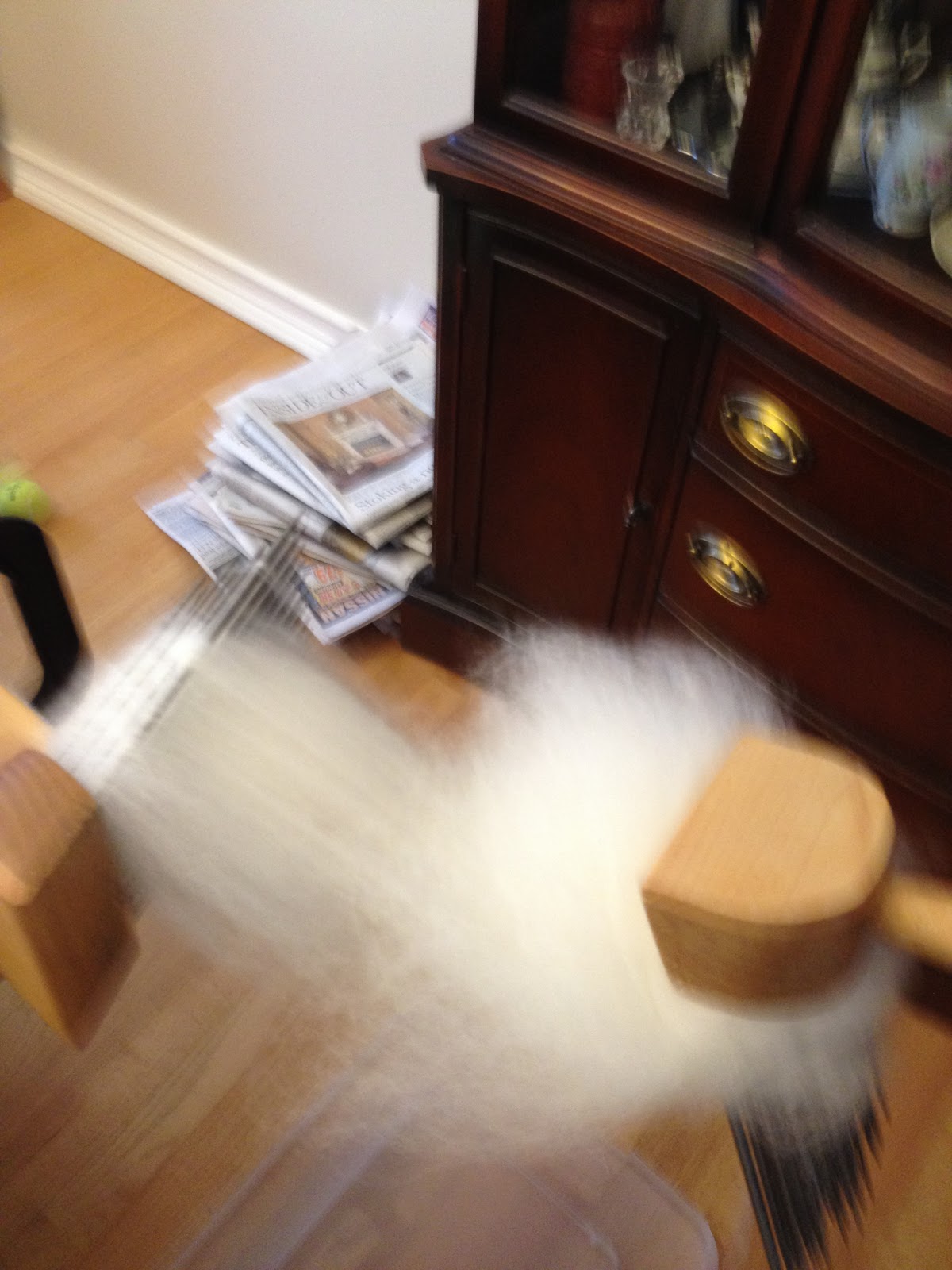
There are two wool combs to a set, and here is how the fleece is combed, off of one comb and onto the other:


You do this for a while until everything is all nice and combed and ready to be pulled off (there is one step I haven't shown, called, "planking"). At that point you pull the fiber off of the combs through a small hole in a tool called a diz :


This turns the fiber into a kind of rope of aligned fiber, which is called top, or sliver:


When you roll that up into a nice little ball for storage, a tiny bit of twist goes into it, and then it's called roving. These balls of roving are ready to spin:


There is always a some stuff left behind in the combs:


It's full of things that you don't want in your yarn, like vegetable matter, tangles and lumps:


I said that as soon as I got my hands on this fleece I knew it was going to be something special. It is. It's incredibly fine and soft. I think it may even be as soft as the paco-vicuna I have. I'll compare the two when I've spun this up. I'm so excited to have a whole fleece of this stuff! And from a local farmer!