Tuesday, April 30, 2013
Getting ready for the Maryland Sheep and Wool Festival!
Getting ready to travel to the Maryland Sheep and Wool Festival this weekend. I'll be taking an all-day class on Friday on The Wonderful World of Wool Types, and then I'll be shopping for fleece and fiber and gawking at all of the marvelous things all Saturday and Sunday!


Thursday, March 28, 2013
Travels...
We're travelling to my niece's wedding and have made a few stops along the way.
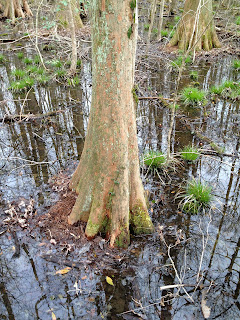
Here is a cypress tree growing in The Great Dismal Swamp, yes, that is the actual name. The Great Dismal Swamp sprawls from Virginia, over the border, and into North Carolina:


And here is a shot of one of the beautiful shores along the Cape Hatteras National Seashore, a protected and natural stretch of island and shoreline:

Sunset from one of the islands:

We will be taking a ferry to the mainland tomorrow, a two hour ride, and then on to the wedding!
Here is a cypress tree growing in The Great Dismal Swamp, yes, that is the actual name. The Great Dismal Swamp sprawls from Virginia, over the border, and into North Carolina:

Here is a live oak on Roanoke Island in the Outer Banks of North Carolina. Roanoke Island is the where the first English colonists landed in 1897. They are now known as the Lost Colony because they disappeared completely and were never heard from again. This particular live oak grows on the northern end of the island, which is the end of the island where the colony was located, and it is old enough that it is believed to have been alive when the colonists were on the island:

Virginia Dare is famous for being the first English colonist born on these shores. She disappeared along with here mother, father, and all of the other colonists, but here is a rendition in marble of what she may have looked like as a young woman. She wears the jewelry of a princess among the Native Americans of the area at the time, holds a fishing net around her, and has a heron by her side. This statue resides in the Elizabethan Gardens, an expanse of gardens on Roanoke Island which were very beautiful, even with only a few things in bloom at present:

This is the Bodie lighthouse on Bodie Island in the Outer Banks:

Sunset from one of the islands:

We will be taking a ferry to the mainland tomorrow, a two hour ride, and then on to the wedding!
Friday, March 22, 2013
Dyeing Cormo wool with dried and frozen marigolds
I recently got my hands on some Cormo wool top. Cormo sheep produce a nice, soft wool and I've been dying to get some and spin it up.
I had a small amount of dried marigolds, and a large amount of frozen marigolds from my garden and I decided to use some of these to give about four ounces of the wool a nice marigold yellow color (you can see another, more in depth, post about dyeing wool with marigolds here). Here's the wool in the dye pot:

And here it is right out of the dye pot before rinsing:


I had a small amount of dried marigolds, and a large amount of frozen marigolds from my garden and I decided to use some of these to give about four ounces of the wool a nice marigold yellow color (you can see another, more in depth, post about dyeing wool with marigolds here). Here's the wool in the dye pot:
And here it is right out of the dye pot before rinsing:
It looks like there's still a lot of color in the dyepot, so I think I'll mordant four ounces of Polwarth wool and toss it in there to take up what's left. Polwarth is one of my favorite wools - soft and cushy. I'm planning on someday making a cardigan for myself out of Polwarth. I haven't found the exact right pattern yet, though, and I'm still thinking about the colors - I think walnut brown will be in there for sure.
I'm thinking that Cormo will become a new favorite, too. Here are the two rovings hanging up to dry, the Cormo, first in the pot, is on the right, and Polwarth, taking up the last of the dye in the second dip, is on the left:
It's always nice to have dyed rovings waiting to be spun. With these two, I think my total of dyed rovings waiting to be spun comes to somewhere around seven.
Wednesday, March 20, 2013
Johnson Woods State Nature Preserve, an old growth forest
Last weekend my husband and I went for a walk through an old growth forest. This particular portion of land had been set aside by the family of farmers who owned it because they wanted to preserve the large trees. Some of the trees in the forest were saplings when the Pilgrims arrived at Plymouth Rock, which would make them over 400 years old. The trees on the forest floor, fallen over from storm damage or dead-fall, were very large.
There were lots of interesting things, like these colorful lichen (click on any of the pictures to see them larger):

Here is a tall tree, taken with the panorama mode on my iPhone:

Here is a picture of the same tree, taken from the top down, instead of from the bottom up, like the previous photo:

Here is one of the fallen trees, covered with moss, which shows that when the canopy is in leaf, not much light makes it to the floor (be sure to click on this one):

The previous picture, and the one below, were both taken in panorama mode with my iPhone. Although the boardwalk pathway was straight, the effect in panorama mode makes it look like it comes to a 'V' where I'm standing to take the picture:

Some moss on an old log swimming in a vernal pool:

Here are some interesting roots:

A large fallen tree in a vernal pool, salamanders will lay their eggs in these vernal pools (click to see larger):

Walking through this old growth forest was different from walking through other forests. There isn't much in the way of underbrush because not much light makes it through the canopy, and there are many more large trees. It was a pleasure to see it, but a little sad that at only 200 acres, Johnson Woods State Nature Preserve is one of the largest old growth forests in Ohio.
Friday, February 1, 2013
Darn socks!
I tried my hand at darning hand-knit socks for the first time. I have a pair of socks that I made out of a blend of baby alpaca, silk and nylon. I thought that with the addition of the silk and nylon, I'd get extra wear out of these socks, but I was horrified one day when I found a hole in one of my socks at the end of the day. Darn! I knew right away that I'd have to learn how to darn socks, because these socks are so fuzzy and comfy, I don't ever want to get rid of them, not to mention all of the work that went into them in the first place (they started out as a raw fleece that I purchased at a fiber festival). I think I even have a post about blending the fibers with my drum carder.
Anyhoo, here was my dilemma:


So I turned to the ever-trusty Youtube to watch sock darning how-to's. There are a surprising number out there, and a few different techniques for fixing those holes, and reinforcing worn spots (this is where the adage, a stitch in time saves nine, comes from).
I picked a technique which involves picking up stitches and knitting a patch right over the hole. Other techniques involve weaving a fix into the hole. Neither one seems too difficult, so I went with the one that I thought would probably look better, although I don't think the woven fix would look bad either. And anyway, who's gonna see it?
So here is my darn:

I looked and looked but couldn't find any leftover of the same yarn (I used what I had left to knit some fingerless gloves - which I LOVE because they are fuzzy and warm - and I think that used up the last of this particular yarn. I do, however, have some yarn from the same fleece, only without the added silk and nylon, so I used that to darn the hole:

It doesn't look terrible:

And it feels just fine when I put it on, so, voila! The darning was a success:

I can now wear my fuzzy, warm alpaca socks again, and just in time since it's 16 degrees F right now.

Anyhoo, here was my dilemma:
A very sorry hole right on the heel:
So I turned to the ever-trusty Youtube to watch sock darning how-to's. There are a surprising number out there, and a few different techniques for fixing those holes, and reinforcing worn spots (this is where the adage, a stitch in time saves nine, comes from).
I picked a technique which involves picking up stitches and knitting a patch right over the hole. Other techniques involve weaving a fix into the hole. Neither one seems too difficult, so I went with the one that I thought would probably look better, although I don't think the woven fix would look bad either. And anyway, who's gonna see it?
So here is my darn:
I looked and looked but couldn't find any leftover of the same yarn (I used what I had left to knit some fingerless gloves - which I LOVE because they are fuzzy and warm - and I think that used up the last of this particular yarn. I do, however, have some yarn from the same fleece, only without the added silk and nylon, so I used that to darn the hole:
It doesn't look terrible:
And it feels just fine when I put it on, so, voila! The darning was a success:
I can now wear my fuzzy, warm alpaca socks again, and just in time since it's 16 degrees F right now.
My feet will love me : )
A winter hike at Nelson Ledges
Last weekend, my husband and I went for a walk in a nearby state park. It was wintry and snowy at Nelson Ledges, which so far has proved beautiful in any season.
There were ice crystals growing up from the ground under ledges of rock (click on any of the pictures to see them larger):

The crystals pushed the soil, pebbles, and leaves up with them as they grew:

Here's what looked like a snowy toilet seat - just in case...:

Here's a little cave close to an icy waterfall, full of icicles:

And here is an icicle forming on a rock face that reminded me of either a hummingbird or a dolphin:

As long as I'm bundled up, I don't mind a wintry walk.
Monday, January 21, 2013
Flax to linen experiment - Spinning the flax
Here is the latest installment on my growing flax for linen experiment. It all started last spring with the planting of the flax. Over the summer it grew, and in the fall I harvested it. After processing the flax plants into flax fiber, I am ready for the next step: spinning the flax. All of the previous steps are documented in various posts which can be found here.
Here is the hackled flax that my garden produced. It doesn't look like much, it's only 1.4 ounces, but keep in mind that only 10% of the flax plant results in fiber, and of that 10% only 3% is the, nice, long kind. The other 7% is tow flax. I do still have a little bit that hasn't been broken and scutched and hackled, but I think the whole lot will still come in at under 2 ounces when all is said and done (click on any of the pictures to see them larger):


I'm hoping whatever I make with my little skein will turn out as soft and flexible:

I still don't have a loom yet, and anyway, I only have a small amount to work with, so I'll be knitting whatever it is that I'll be making. It'll probably turn out to be a small kitchen cloth/towel. If I wait to see if I get something good out of blending the tow flax and cotton, perhaps I can make something else. In any case, that's the next step in the experiment, and fodder for another post.
Here is the hackled flax that my garden produced. It doesn't look like much, it's only 1.4 ounces, but keep in mind that only 10% of the flax plant results in fiber, and of that 10% only 3% is the, nice, long kind. The other 7% is tow flax. I do still have a little bit that hasn't been broken and scutched and hackled, but I think the whole lot will still come in at under 2 ounces when all is said and done (click on any of the pictures to see them larger):

Now, I do have a bag full of tow flax which brings the total up to about four ounces or so. The tow flax is what's left in the hackle after hackling the flax. The tow flax is shorter. I'll probably card it up, and maybe experiment with blending in some cotton, and spin that up later.
It can't be any courser than the longer flax. I'm not sure if the coarseness and stiffness is due to the quality of my particular garden flax (it grew under near-drought conditions), or that I didn't pull it at the optimum time, or that my retting, breaking, scutching, and hackling leaves something to be desired:

Here's my hackle:

It's an antique, really, made in 1834, but it's still sharp and sound and got the job done. I found it on ebay and paid $70 for it. I don't think anyone still makes these, at least I haven't found any contemporary ones in my searches:

So, my bundle of hackled flax is roughly the length of my arm:

I divided it in half, spun it onto two bobbins, and then plied it:

The resulting skein is about 119 yards long:

It's rough and stiff right now:

But the thing about linen is that with washing it will soften and relax. Here's little swatch of linen that I knitted up a couple of months ago with a small amount of the flax that I processed before all the rest:

I spun this a little bit finer than my skein above. I'm not a proficient flax spinner, I have lots of room for improvement:

You can see that it is a bit 'hairy', but it's soft and flexible:

I still don't have a loom yet, and anyway, I only have a small amount to work with, so I'll be knitting whatever it is that I'll be making. It'll probably turn out to be a small kitchen cloth/towel. If I wait to see if I get something good out of blending the tow flax and cotton, perhaps I can make something else. In any case, that's the next step in the experiment, and fodder for another post.
Tuesday, January 1, 2013
Dyeing milk protein fiber and de-hairing Paco-vicuña
The mail brought a wonderful thing to my doorstep yesterday - this raw Paco-vicuña fleece:

Well, that's really just the blanket, not the whole fleece, but I have the rest, too.
Like alpaca, Paco-vicuña needs to be de-haired before it can be further processed. In this picture, you can see the guard hairs sticking up from the rest of the fleece:

The fleece has a micron count of 16.3, pretty darn fine. The guard hairs are stiffer and thicker and need to be gotten rid of so that they don't spoil the fineness of the rest of the fiber. I don't know how this is accomplished by machinery in a mill, but if you are doing it for yourself, the hairs must be pulled manually from the rest of the fleece. It's not hard, it just takes a while.
Here you can see the bit of fleece from the above picture after it's been de-haired:

All that's left is the wonderful, fluffy, Paco-vicuña fiber. Now it's ready to be washed (soaked, really) and then further processed (I'll probably card it as it's a little short for combing) so that it can be spun into luscious Paco-vicuña yarn.
I also had the chance to dye up some recently spun milk protein yarn. The milk protein was in a wonderfully big box full of spinning fiber that was under the Christmas tree. Milk protein, made from milk in a similar way that bamboo fiber and tencel fiber is made, is wonderfully silky. It breaths well and contains anti-microbial amino acids (which can help with the stink factor in sweat).
I had two 2 oz. skeins to dye up. The pinky-orange-yellow color was achieved by winding the skein into a ball and then squirting pink and yellow weak acid dye (set with vinegar) into and all over the ball. The color was set with heat by microwaving the ball for about 3 minutes.
The golden color of the other skein was achieved with a natural dye made from Tesu flowers, the extract of which I ordered online. I mordanted the skein with alum first, and then plunked it into the dye pot. The golden color, particularly on the shiny, silky milk protein fiber, is luscious and exactly what I wanted:

I'll be using this yarn when I go to a Knitted Knockers Knit-in next week where we all will be knitting prosthetic breasts to donate to women who've had mastectomies. Lot's of these women really like knitted boobs over the silicone prostheses because they're more realistic, breath, can be worn with their regular bras, and can be adjusted by adding or subtracting the amount of fill.
I'll be spinning the rest of my milk protein and dyeing it up in anticipation of the knit-in next week. And then, I'll be concentrating on Paco-vicuña, of course!
Wednesday, December 12, 2012
I've got the Slytherin scarf started, hooray!
I finished the Gryffindor scarf and have begun the Slytherin one - ten points to me!!

Saturday, December 8, 2012
Aack! This scarf is going to kill me! - or - Knitting things from movies, books, and TV shows
My son asked if I could knit some scarves for him and his girlfriend for Christmas. Specifically, a Gryffindor scarf and a Slytherin scarf. There are a few different patterns out there, so I asked which type he wanted. He chose, I bought the yarn, and started knitting away. Scarves are usually pretty easy.
This one is easy, yes, but time consuming, and LONG. My husband is out of town for several days, and I thought this would give me lots of time to put into knitting. Gaaa! I think there's a spell on my needles, or something. I've been knitting, all told over the past few days, for HOURS AND HOURS and the scarf seems to grow only incrementally - soooo slowly. And it's only half way done. Gaaa! What was I thinking??
And notice the green and silver yarn in the corner? That's for the Slytherin scarf, yet to be cast-on. I say again, GAAA!


This one is easy, yes, but time consuming, and LONG. My husband is out of town for several days, and I thought this would give me lots of time to put into knitting. Gaaa! I think there's a spell on my needles, or something. I've been knitting, all told over the past few days, for HOURS AND HOURS and the scarf seems to grow only incrementally - soooo slowly. And it's only half way done. Gaaa! What was I thinking??
And notice the green and silver yarn in the corner? That's for the Slytherin scarf, yet to be cast-on. I say again, GAAA!
I've knitted things from movies and books and TV shows before, usually as gifts. Some have been specific requests, like the Jayne Cob hat I made for my son (from the TV show, Firefly). You can see him wearing it in this post - scroll down to the end.
I also made some fingerless mitts fashioned after the ones Johnny Depp wore in the movie, Sweeney Todd, for my daughter's boyfriend. He loves them and wants another pair because these are about to wear out (they are 2 or 3 years old by now and he wears them all the time in winter). The problem with that is I sort of cobbled the pattern together and customized it for his (large) hands, but now can't find my notes. So I have to go through the process of cobbling together and customizing all over to make new ones. Gaaa!
And here are some mittens I made from the excellent book, Code Name Verity, for a friend.
I would someday like to knit the fingerless mitts Hermione wears in The Deathly Hallows Part 1 for myself (click the image to see it larger):

And then, there are the Beowulf socks I intend to make for my son someday - they have the first page of Beowulf written on them. I made the yarn already, but the pattern is a bit daunting, so I'm nervous about starting.
So there is no end to the inspiration that can be found in literary, film, and television sources - and the requests that may come your way if you are a knitter. My only advice to you is, STAY AWAY FROM THESE BLEEDING SCARVES. If you must, knit one of the other styles that can be found. You'll be glad you did.
Friday, November 30, 2012
Maddie's Mittens from Code Name Verity
I recently read the excellent book, Code Name Verity, by Elizabeth Wein. It's set during WWII, and mentioned in the book are a pair of handknitted mittens which enable the wearer to free the fingers when needed. The author found the 1940's pattern for the mittens while doing research for the book. She included a link to the pattern (see this post for details).
Anyhoo, my book club read the book for this month's selection and I decided to knit the mittens as a gift for the person in the club whose birthday it was this month, seeing as it went along with the book we had just read.
Here is the finished product. I knitted them with some of my handspun yarn - this happens to be Gotland lambswool. It was the only thing in the correct gauge that I had on hand which wasn't listed for sale already in my Etsy shop:

You can see that an upper flap is designed to tuck into a lower flap:

Here you can see the top flipped back:

On the hand:

And with the top flipped back to free the fingers:

I knitted them with a set of new needles that I recently got. You can see in the picture that they are square instead of round. The reviews said that they helped eleviate arthritis pain and carpal tunnel that can arise from knitting. I have both. These really did help with the arthritis - a lot! The carpal tunnel, only so-so. I think the shape helps the yarn stay on the needles better, so you're not gripping everything so tightly to keep from loosing stitches off the ends of the double points. The only drawback is that they are VERY pointy and sharp:

I had finished everything but the thumb of the left mitten by the time book club met last night. I showed my friend the mittens and told her I'd get them to her as soon as that thumb was finished, which I was able to do this morning.

By the way, Gotland lambswool is the same fiber that was used to make the Elvish cloaks in The Lord of the Rings movies. I believe that the cloaks were actually woven with a blend of Gotland and alpaca, and maybe something else, I can't remember. It's not a very soft wool, it's actually rather scratchy, but just fine for mittens and cloaks : )
Here is a book trailer for Code Name Verity :
Subscribe to:
Posts (Atom)


 Posts
Posts


