Monday, October 31, 2011

Happy Halloween!

Here are some Halloween sights, taken yesterday on the search for jack-o-lantern pumpkins. Click on any image to view it larger:

One of the many pumpkin farms we stopped at.

A spooky, old building. Is it haunted? I don't know.

Fun gourd witches at another pumpkin farm.

And, of course, pumpkins!

A mini haunted house.

This pumpkin bale wishes you a Happy Halloween!

Friday, October 28, 2011

Last Weekend's Craft Fair

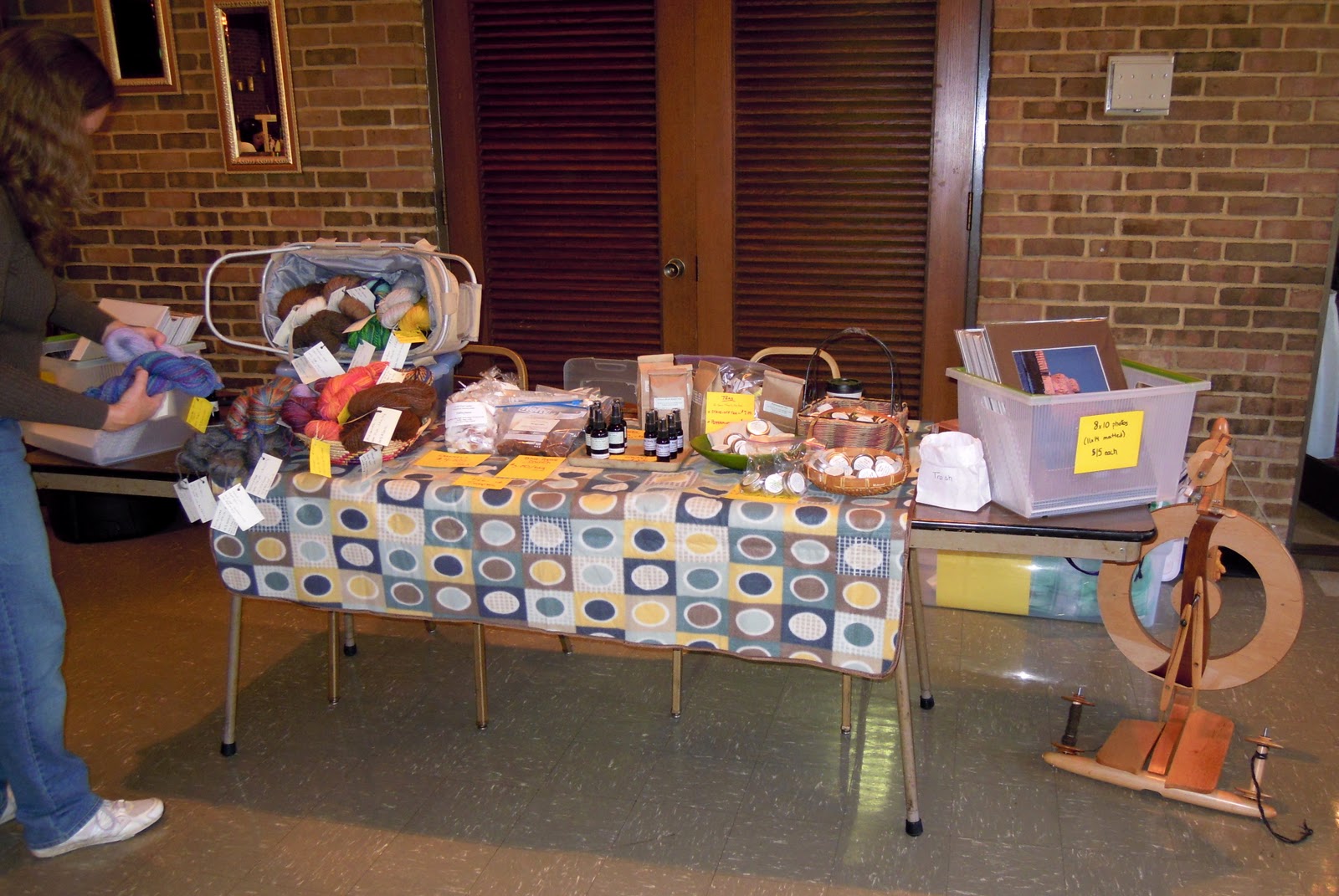
Last Sunday I hauled all of my wares to an arts and crafts fair which featured northeastern Ohio Etsy shop owners. Here I am setting up my table:


My husband prepared some of his photos for sale, too:


And my daughter came to help me:


We had a lot for sale and we sold some of everything we brought: homemade candy, hand crafted herbal products, handspun yarn, photos, books. As you can see, I also brought my spinning wheel to show how the yarns were made.


We did okay, but the attendance wasn't huge. I was hoping to do a little better. It's kinda hit and miss with craft shows.

Thursday, October 20, 2011

Being Female

I belonged to a religion for eighteen years, almost everyday of which I felt caged or different because I didn't quite fit that religion's definition of femininity. I was constantly told what being female meant and what my life would hold for me, and that I would like it. I was living someone else's idea of what my life should be because I am female.

I hold to no religion now. I am my own person, or at least I am learning how to become my own person. It takes a while to flush out the dogma.

Here are a couple of quotes that I've come across lately that echo my sentiments, but say it so much better than I could. The first is from a couple of YA authors who write strong female characters. They were on a panel from which an attendee drew a list of advice on how to make a kick-ass Young Adult heroine. Here's one piece of advice:

Ignore orders from both sides.


[Tamora] Pierce discussed how upsetting it was for her, who grew up during the feminist revolution in the ‘70s, to arrive at college and have women saying that “real” feminists were gay or celibate. (“I was neither,” she quipped.) This debate extends to her female characters, as mentioned above. “The whole point of what we did was giving every woman the power to choose how they wanted to live,” she said. “Not to present only restrictions on women, but to present the possibilities that come from being female.”

“The thing about being female,” [Esther] Friesner said, “is that it makes us think there’s only one way to be female. I’ll bet there’s at least two or three, or six, different ways in this very room. There is no one female… Sometimes the biggest battle is ‘This is what you should be doing,’ handed down by the feminists or by the anti-feminists.”
And here is the second quote, from Steve Jobs' 2005 commencement address to the graduating class at Stanford University:

“Your time is limited, so don't waste it living someone else's life. Don't be trapped by dogma — which is living with the results of other people's thinking. Don't let the noise of others' opinions drown out your own inner voice. And most important, have the courage to follow your heart and intuition. They somehow already know what you truly want to become. Everything else is secondary.”

Don't be trapped by dogma. Trapped is exactly how it feels, and if you feel that way, start asking questions and then find the answers out for yourself.

Wednesday, October 19, 2011

Making caramel

I usually don't make caramel until December so that I can send it off to friends and family far away. Today as the warm, sweet caramel smell filled my kitchen, I had to keep reminding myself that it's not December. This batch of caramels won't be tucked in with Christmas gifts, though. I'll be selling it at my booth at the upcoming Art and Crafts fair I'll be attending this Sunday.

Who wants to lick the pot?

 I'll also be selling my homemade herbal products, handspun yarn, and some of my husbands photos.

Caramel poured out and cooling.

And, of course, I'll have copies of my books on hand. I usually sell a few at these types of things, and with Christmas looming closer, some people might be interested in my Christmas book, My Twelfth Christmas. It certainly smells like Christmas in my kitchen right now!

Monday, October 10, 2011

Texting Mittens Knitted from Handspun Yarn

These are some texting mittens that I knitted out of some of my handspun yarn. They're for my daughter:


The gray inner glove is yarn I that spun from some angora/wool/silk blend roving that I purchased from the Crooked River Fiber Fling last August. The lavender outer mitten is yarn that I spun from some superwash Bluefaced Leicester that I dyed with a dye made from elderberries.


My son wants a pair, which I'll make using yarn that I'm planning to spin from some cozy, brown yak down. My husband will get a pair, too, only he'll use his while pursuing his hobby in the winter months - outdoor photography. His will have a little bit of nylon (he's worried about durability) and a pinch of quiviut (musk ox - just about the warmest fiber there is) blended in with the yak.

The pattern I used can be found in the Fall 2010 issue of Spin Off magazine.

Friday, October 7, 2011

A re-post from way back in October, 2008: Magical Thinking and Cornish Witchcraft

An article in the November/December 2008 issue of Archaeology Magazine talks about witchcraft in Great Britain. Recently, an archaeologist uncovered strange pits while doing work to extend a barn on her property in Cornwall. She has since brought students out to help her uncover several more pits and an ancient spring, all filled with what she believes is evidence of witchcraft spanning many centuries, including the 20th.

Many of the pits were lined with the skin (including the feathers) of a swan, on top of which were placed varying amounts of eggs almost ready to hatch, pebbles, and bird parts and claws from various types of birds. The spring was lined with quartz and contained things like nail clippings, human hair, straight pins, and small pieces of cloth. Part of a cauldron was even found.

Quoting from the article, the archaeologist, Jacqui Wood, said:

"Over the last 30 years I've been quick to dismiss ritual as an explanation for unusual archaeological finds. It usually means that the archaeologists can't think of anything better. So now it seems especially ironic that I end up with a site absolutely full of ritual."
The earliest dates for the pits are the mid-1600s. Whatever was being done here was important enough for the practitioners to risk being pointed out as witches. The 1600s were a dangerous time to be caught doing anything with a pagan tinge. It was doubly risky because swans were symbols of royalty and owned by the crown. And apparently whatever these practices meant is still important. One of the pits dates from the 1950s. It was lined with the skin of a dog and contained dog teeth and the baked jaw of a pig.

Old magic and magical thinking is still among us.


Monday, October 3, 2011

Spinning at the Harvest Fest

I live right next to a park which used to be a farm. The farmhouse and barn are still there and are not a part of the park. They're owned by a foundation which has been restoring them to their early 1800's glory. My little town was a hotbed of Abolitionist activity back then and many of the houses were stops on the Underground Railroad, this one included. So I was excited to volunteer to demonstrate spinning in the farmhouse during Case-Barlow Farm's Harvest Festival yesterday.


The day was windy and cold, so it was nice to be inside. There were lots of activities outside, like butter-churning, candle-dipping, pumpkin-painting, and demonstrations of rope-making, chair-caning, and civil war troops in a camp, among other things.

Lots of people came through the farmhouse and it was fun to talk to them about spinning.

Wednesday, September 28, 2011

Spinning this weekend at the Harvest Fest

I'll be demonstrating spinning this Sunday in the farmhouse at Case-Barlow Farm's Fall Harvest Fest. If you're in Hudson, Ohio this Sunday, Oct. 2nd, drop on by!

Here are links to pictures of the farmhouse and the barn.

Now I've got to go wash some wool so that I have something to spin.

Sunday, September 25, 2011

Late-season harvest

Garden production is winding down. I still have a few tomatoes ripening, and there are still a few greenbeans to be had, but the peppers will soon be finished, and there is less and less to pick each time I go out to gather things.

My sunflowers are just now becoming ready for harvest. I cut two big heads from my far away garden today and brought them home. I grew two varieties, Mongolian Giant, and Titan:


There are still many heads out in the garden. I got the seeds out of these, rinsed them quickly, tossed them with some sea salt, and roasted them.

Here's what else the gardens gave me today. I'm afraid that's the last of the okra. This time of year, the deer will eat it to the ground, even if it wants to keep producing. They really like the okra. And beets. My beets had a hard time this year because of the deer, notice that there aren't any in the pic:


My gardens are never especially heavy producers, but I enjoy the process, and cooking with whatever fresh things they want to give me. During the winter, we'll continue enjoying things that we've either frozen or dried.

And as far as the herb gardens go, I still have a lot of holy basil to gather and dry, elecampane and evening primrose roots to dig, probably some lemon balm, too, and, of course, there's always peppermint. Lost of things on the drying racks are waiting to be put into airtight jars, and I have oils to infuse and tinctures in various stages of processing. So there is still work to be done.

Thursday, September 22, 2011

Bison Chili

We've been enjoying Bison chili a lot over the past several weeks. One thing I like to make with the peppers and tomatoes from the garden is chili.

Early on in the season, when I didn't have enough ripe tomatoes of my own, I made a trip to the farmer's market to buy some so that I could make a batch of chili up with some ground beef I had in my freezer. While there, I happened to stroll by a booth where a man was selling locally raised, grass-fed bison meat. I decided to try making the chili with ground bison instead of my ground beef.

My whole family loved it. My son and daughter have said that they think it's the best chili they've ever eaten. So I've been making bison chili now. I use heirloom tomatoes, peppers, and garlic from my garden, and onions and ground bison from the farmer's market. The beans I buy in cans from the grocery store.

It's so fun to walk out to the garden, fill a basket with tomatoes and peppers, and then walk back inside and put it all into a pot along with the cooked ground bison, onion and beans for a flavor-rich dinner.

Yum.

Friday, September 16, 2011

Dyeing with cleavers root and pokeberries

Yesterday was dyeing day. It was a lot of trouble for just over 3 ounces of wool, but it was good to learn the process for these particular dyestuffs (cleavers root and pokeberries), and to see the resultant colors. (My previous post is about gathering the roots and the berries, if you're interested.)

Dyeing with cleavers roots:

My process isn't well documented photographically because I did the cleavers alone in the morning before my daughter was able to come and help, but here's what I did:

I let roots soak overnight. In the morning I blended the roots up with un-softened well water from our outside tap. I read that hard water helps with the color. I put the blended roots in the dye pot along with more well water and heated it gently for an hour. 

When dyeing with cleavers, it's very important to regulate the temperature. I read that over about 140 or 150 degrees F, the color will start to move from reds, toward the brown shades. To keep it in the red range, the process shouldn't go over 180 degrees F. One source said that the best reds are obtained at about 140 degrees. It was hard to find the sweet spot with my electric stovetop, so while making my dye bath, the temp at one point reached about 178 degrees F. I did eventually find how to keep it lower.

While the roots were steeping, I mordanted my wool. I had 4 ounces of cleavers roots, so with a ratio of 2:1 of roots to wool, I measured out 2 ounces of wool (which happened to be superwash Bluefaced Leicester). I added 1/2 teaspoon alum powder and 1/4 teaspoon cream of tartar to another pot of well water and gently steeped the wool in it for about 40 minutes. 

When the roots had heated for an hour, I strained them out and then added the mordanted wool to the dye bath. I let the wool steep between 150 and 160 degrees for an hour. After that hour, I let the wool cool in the pot, then rinsed it until the water ran clear, with one of the changes of water a bit soapy.

The wool came out a very pretty salmon color (the picture doesn't do it justice); here it is after rinsing: 


Cleavers is very much like madder apparently, and depending on the quality of the roots, the concentration of the dye bath, the temperature, water hardness, etc, your resultant color can range anywhere from orange-ish, to salmon, to a nice red, to brick red, to various browns. I got a very pretty salmon with which I am very happy.

On to the next.

Dyeing with pokeberries:

My daughter showed up to help with this batch, so it's got lots of pictures.

First, a word about dyeing with pokeberries. It isn't usually done because the color doesn't last; it fades very quickly. This is a new method of dyeing with pokeberries that I came across in this book. The woman who discovered the process has yarns dyed with pokeberries that are ten years old and still vibrant and beautiful. Beautiful is the operative word. The color obtained from pokeberries is absolutely amazing.

My daughter and I gathered about two pounds of pokeberries. The ratio of pokeberries to wool is very high, 25:1. This meant that I could only dye a little over one ounce of wool. Disappointing, I know, but I'm hoping to plant pokebushes next year so that I can have my very own berries to harvest, hopefully in larger quantities.

A word of caution: pokeberries are poisonous, don't eat them.

So, first we stripped the berries from the stalks:


And then proceeded to mash them all up:


It's best to wear gloves for this part:


Only, make sure you don't have a hole somewhere:


This method of dyeing with pokeberries uses vinegar as a mordant, and vinegar is added to the pot while making the dye bath.

Cover your berries with water, making sure you have enough to let your wool swim freely. For each gallon of water used, add 1/2 cup vinegar. I added a total of one gallon of water to my berries, so I put 1/2 cup vinegar in the pot with it.

This is another material which is temperature-sensitive. Keep the temperature between 160 degrees and 180 degrees F. If there is any bubbling or boiling, the color will be ruined. After the cleavers, I had a handle on keeping the temp where I wanted it.

Here are the berries stewing in the pot. I skimmed that foam off; it didn't disappear and I didn't want it there when I put the wool in:


The berries steeped for an hour. While they were doing their thing, I mordanted the wool by adding about 1/4 cup of vinegar for my just-over 1 ounce of wool to a pot of water. I steeped the wool in the vinegar water for about 40 minutes.

When the berries had finished steeping, I strained them out and then added the mordanted wool to the dye bath. The wool stewed in the dye bath for 2 hours. I kept the temp between 160 and 170 degrees the whole time:


When the two hours was up, I put the lid on the pot, took it off the heat, and let it sit overnight. In the morning I rinsed the wool. Have you ever seen such a wonderful color? And from a natural dye!:


I love it! Totally worth all the effort.

Here are the two colors from the two different dyestuffs hanging to dry, pokeberry on the left, cleavers on the right (click any picture to see it bigger):


I can hardly wait to spin these up. For these colors I will definitely go through he whole process again (only next time, I'll try to leave out the part about getting poison ivy).

Thursday, September 15, 2011

Gathering natural dyestuff - or - The adventure in which I get poison ivy

I've been up to more dyeing. The other day, I gathered more marigolds from the garden along with some wild goldenrod, and threw the flowers into the dye pot along with some onion skins and some marjoram from the herb garden. All of these things make yellow. Here's the hodgepodge in the dye pot:


It dyed my superwash BFL roving a nice goldish-yellow.

Yesterday, my daughter and I went on a little adventure to gather more dyestuff. I've been dying (ha!) to get out to a place I know where a ton of cleavers grows. Cleavers is related to madder, and like madder, cleavers roots will make a red dye.

So, off we went, bushwhacking our way through waist-high brush and brambles. The dog was smarter and took off on his own. We learned that he found the deer trail right away that we had been hoping to run across. Next time we'll follow the dog.

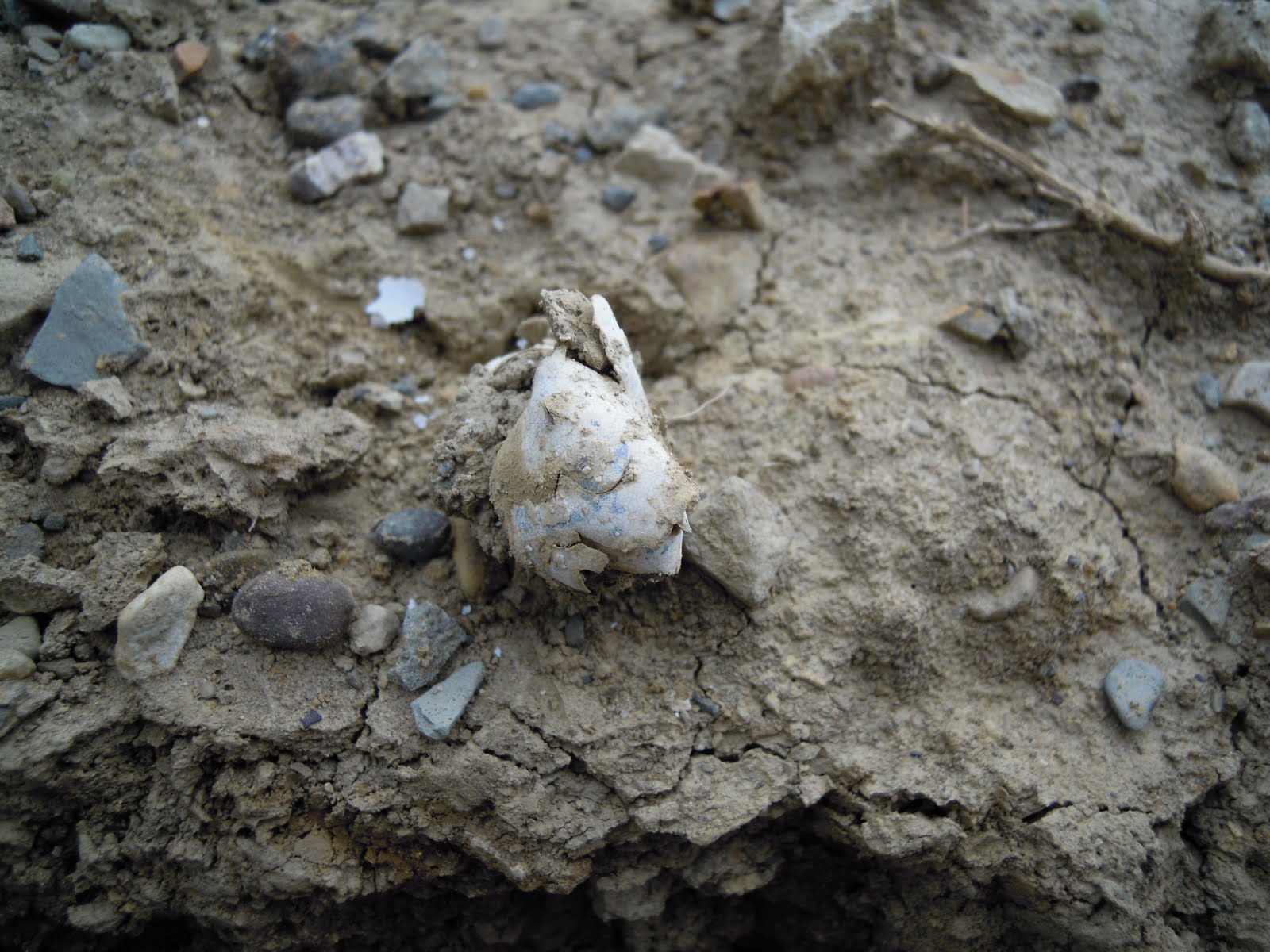
While crossing the railroad tracks, my daughter spotted some sort of buried egg nest that had been dug up by a coyote (we found dung nearby). The round, leathery eggs had been eaten. We guess they were tortoise or snake - anyone out there care to take a guess? Some of the eggs seemed to have bluish speckles, but that may have been something other than speckles.

Here's the dug-up nest:


A close-up of one of the egg remains:


Anyhoo, we did eventually reach the cleavers. Digging cleavers is hard going. It's hard to find a clump of cleavers that will yield a substantial root. And interspersed amongst the cleavers was poison ivy. We tried to be careful, and we washed with Tecnu poison ivy scrub when we got home, but I woke up with poison ivy on my forearms this morning. Good thing I make the best ever poison ivy itch relief spray.

When we got back home, I sprayed the dirt off of the roots with the garden hose outside. Here's a nice root:


And here's our clump of roots, all washed and ready for soaking. You can see how they're reddish in color:


We gathered about 4 ounces. I was hoping to get at least 8 ounces, but we decided to cut the gathering short when we began to feel raindrops. I'm hoping the 4 ounces of roots will dye at least two ounces of wool.

Our gathering wasn't done for the day, however. My daughter knew where we could gather a good amount of pokeberries. I've recently read about a method to make a really nice reddish dye using these berries (which are poisonous, so no eating!) using vinegar as a mordant. I've been wanting to try it, so off we went to gather pokeberries before the sun set.

We gathered about two pounds of berries. Amazingly, this will only dye about one ounce of wool. The ratio of dyestuff to wool for pokeberries using this method is high - 25:1. Here's a peek into one of our bags of berries:


Today I'll be busy dyeing.

We also found a patch of blooming tickseed flowers on our wanderings. Tickseed flowers are yellow, but make a pretty, orange dye. We may go back for those. Not sure yet. I'll be busy enough today as it is.

Sunday, September 4, 2011

Dyeing wool with marigolds

I have a multitude of marigolds blooming in my faraway garden. I planted them in hopes of using them as dyestuff. So today I walked out to my community garden plot to harvest marigolds. I came back with a large basketful.

I measured out about 12 ounces of marigold flowerheads. I put them in a pot and covered them generously with water. I read that marigolds make an intense dye bath, so I wasn't particularly worried about it being too diluted.

I simmered the marigolds for about 30 to 40 minutes (click on any picture to see it larger, then click back arrow to return to blog):  


While the dye bath was simmering, I mordanted my wool. I measured out 4 ounces of superwash Bluefaced Leicester roving, and also grabbed a handful of rolags I had lying around, some from my Christmas fleece (a local wool of unkown type, given to me last Christmas), and some made from Cotswold sheep fiber that I have.

Mordanting about 4 ounces of wool meant measuring about 1 tablespoon of alum powder and one teaspoon of cream of tarter into a pot of water, bringing it to a simmer, adding the wool, and simmering for about 30 minutes.

After the marigolds had finished simmering in the dye bath, I strained them out:


I had lots of leftovers which didn't make it to the dye bath, so I'm freezing them for later use. Here they are laid out on a pan in the freezer, ready to turn all frozy:


With the wool mordanted, and the dye bath ready, I plunked the mordanted wool into the dye bath. I simmered the wool in the dye bath for about 30 minutes:


When the wool was done simmering, I took it out of the dye bath and let it cool to room temp. Then I rinsed it and hung it to dry:


The two rolags on the far left are the Cotswold wool, next comes a few rolags from my Christmas fleece , and the looped-several-times-over-the-bar stuff is the superwash BFL. I've found so far that superwash BFL takes natural dyes up really nicely into slighty richer colors than other things in the same dye pot.

Rolags (fiber carded with hand cards and then rolled off for spinning) are probably not the best form in which to dye fibers, but I mostly did it to see how the Christmas fleece and the Cotswold would take up the dye. It hasn't dried yet, but I think the superwash BFL is my favorite, followed by the Cotswold, and then the Christmas Fleece.

Wednesday, August 31, 2011

Book giveaway begins tomorrow, Sept.1st!

My Goodreads givaway for My Twelfth Christmas starts Sept. 1st and ends Sept. 30. Enter for a chance to win one of three copies being given away!


Goodreads Book Giveaway


My Twelfth Christmas by Linda Ash


My Twelfth Christmas


by Linda Ash


Giveaway ends September 30, 2011.
See the giveaway details
at Goodreads.


Enter to win


Saturday, August 27, 2011

I'm getting a drum carder for my birthday!

I just bought this through an auction on eBay:


It's my birthday present! I can't wait 'till it gets here. I have a lot of fiber that needs processing. Ever since I gave myself tennis elbow while weeding dandelions from the front yard last spring, the combing with the wool combs has slowed down.

Carding fibers will produce a different end product in the spun yarn vs. combing the fibers, so I won't give up combing altogether. I'll still prepare fibers both ways, depending on what type of yarn I want to make. And I have lots of alpaca, wool, and angora waiting to be prepared and spun!

Thursday, August 18, 2011

Grow Your Own Clothes: The Fibershed Project

Read about The Fibershed Project, textile artisan Rebecca Burgess's one year commitment to wearing clothes made from fibers found within a 150 mile radius of her home, here.

And visit the Fibershed blog, here.

Truly inspiring.

Wednesday, August 17, 2011

Far Away Garden Update

Here's what my far away garden (which is what I call my community garden plot) looked like about a month ago in mid-July:


And here it is as of today, in mid-August (the plethora of tomatoes to the left are not mine - they're the next garden over; and the garden to the right of mine has been overrun with weeds):


I love my two rows of sunflowers. Someday in the not-too-distant future they'll bloom. I have two varieties, Mongolian Giant and Titan. They've gotten so tall!:


Here's a shot looking up between the two rows of sunflowers.


I planted pole beans with them so that the beans could use the sunflower stalks as poles. I've had a lot of Japanese beetle damage to my beans. They love bean foliage, especially if it's high up. I have to squat and move between the tall sunflowers in order to gather beans from time to time. I love being in there between the tall stalks. It's like having a little sunflower hidey-hole.

I'm getting beans and okra and peppers and tomatoes from the garden now. The corn will be ready to pick soon, and eventually the beets (if the deer leave me any). I've been cutting my marigolds as they bloom and hanging them to dry. I'm hoping to gather enough with which to dye some wool.

I've had some deer damage. They really love the beet tops and okra. I'm glad I planted three rows of okra. The first row is taking the brunt of the dear damage, leaving the other two to produce.

Friday, August 12, 2011

Dyeing wool with elderberries

Yesterday, I dyed just about 4 1/2 ounces of wool with elderberries. I had about 1 pound of berries with which to make the dye bath. I mordanted the wool with alum and cream of tarter.

I added about a tablespoon of vinegar to the dyebath. I read that adding vinegar to the elderberry dyebath will strengthen the red/purple color, and adding salt to the bath will turn it more toward the blue hues. I was going for the red/purple. I knew that the final color would be much lighter than the bath color, and I didn't want the blue hue to end up more of a pale slate-blue/gray on the fiber.

I  almost-simmered the mordanted wool in the dyebath for an hour and then took it off the heat and let it sit in the bath overnight. This morning I rinsed the wool and it's now hanging to dry:


On the left is almost 1/2 ounce of wool from my Christmas fleece that I combed up during demonstrations last weekend at The Crooked River Fiber Fling. On the right is 4 ounces of superwash Bluefaced Leicester.


It came out a very nice color. The color on the superwash BFL seems more pronounced. Different fibers will take dye up each in their own way, and superwash will take up dye differently from non-superwash.

Monday, August 8, 2011

The Crooked River Fiber Fling

Over the weekend my daughter and I sold our wares at The Crooked River Fiber Fling in Peninsula, Ohio. It was a hot and muggy weekend, but it was a lot of fun.

Here's our vendor booth - I was The Roving Spinner:


We displayed various fibers, spinning tools, and gave demonstrations (click on any of the pictures to make them bigger, then hit the back arrow to return to the blog):


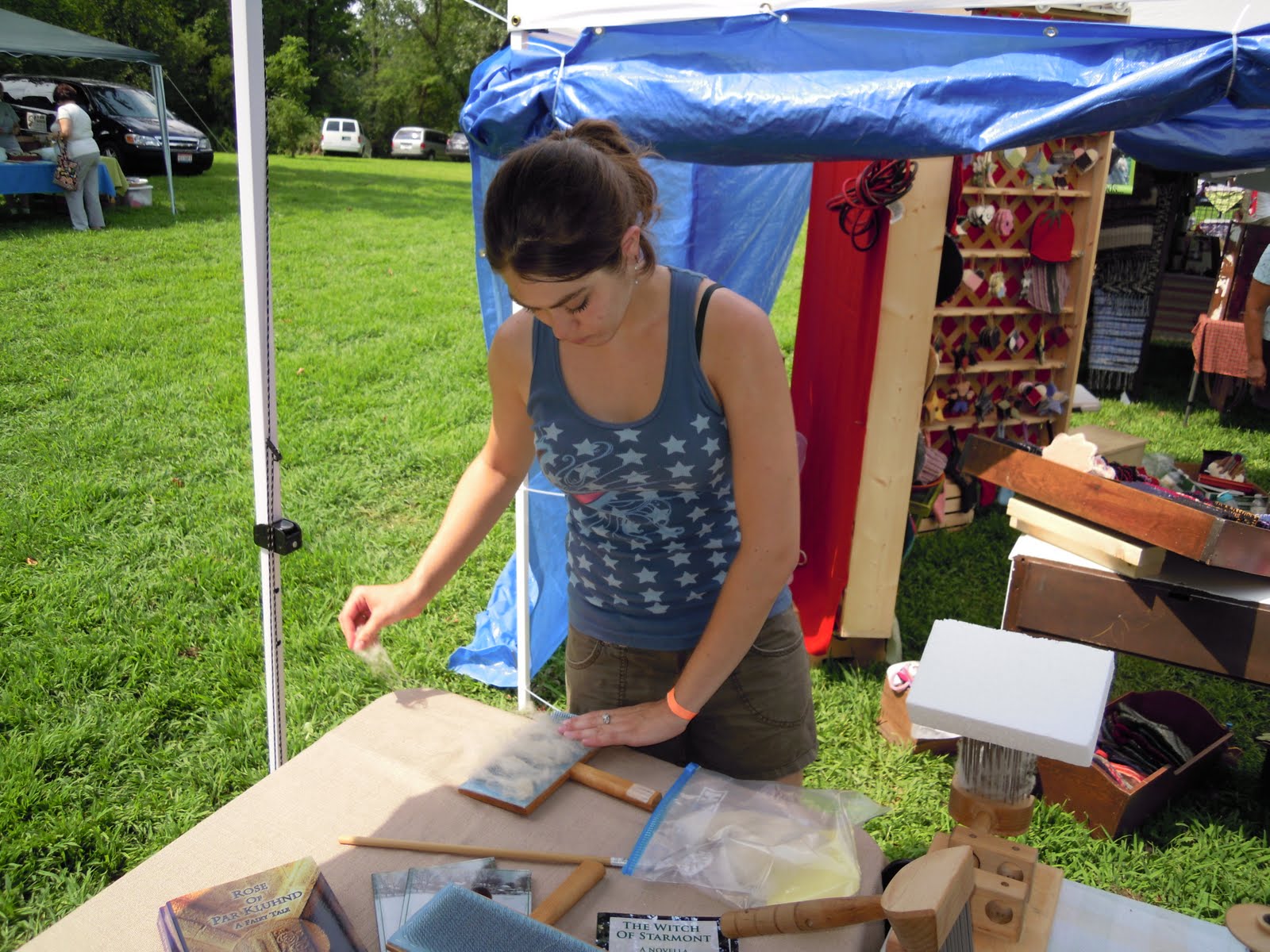
I combed wool with the wool combs and Jessica demonstrated carding. Here she is loading the hand cards:


I also brought along my Kromski Fantasia wheel and demonstrated spinning. There were lots of wheels there amongst the vendors, spinning all weekend long:


Of course, I couldn't pass up the opportunity to bring my books along, a few of my salves, and my poison ivy itch relief spray. Here we are on the second day, taking a lunch break behind all of our non-fiber wares:


We had a great time talking with people about processing fiber and spinning, and my daughter was a great help. We sold quite a bit of everything, and on the last day, the last set of musicians who played over at the live music tent did a shout out for Linda over at The Roving Spinner. They played one of my favorite songs - Marie's Wedding. They had all come over to our tent earlier to ask all about processing fibers and spinning, and when they said they played Celtic music, I had asked if they knew that song. It was so fun to hear them play it for me!

There were animals there, too, alpacas, sheep, and angora rabbits. I scored three or four pounds of fiber - raw suri alpaca fleece, raw baby alpaca fleece, angora, Romney roving, and an angora/wool/silk blend. I can't wait to get spinning with all of it!